November 2026 · Industry Review
Automated Fiber Placement (AFP) has become the backbone of high-performance composite manufacturing. By laying carbon fiber prepreg or thermoplastic tows onto a mold with computer-controlled precision, AFP machines deliver the repeatability, fiber steering and material efficiency that hand lay-up simply cannot match. The global AFP/ATL equipment market, valued at roughly USD 450 million in 2025 and projected to grow at nearly 7% annually, is driven overwhelmingly by aerospace and defense, with fast-growing demand from renewable energy, eVTOL, hydrogen storage and industrial applications. Within this consolidated market, a small group of engineering houses controls the critical intellectual property for multi-axis placement heads, tension control and advanced software. Here are five of the world’s leading AFP machine manufacturers.
1. Electroimpact (USA)
Electroimpact, headquartered in Mukilteo, Washington, is widely regarded as the global leader in large-scale AFP and automated tape laying for aerospace primary structures. The company is known for its modular AFP head designs, extremely high deposition rates, and turnkey automation cells. Its machines lay up wing skins and spars for the Boeing 777X program, and it built the giant AFP system used by Rocket Lab to produce the carbon fiber structures of the Neutron rocket. In 2025, Spirit AeroSystems accepted a first-of-its-kind robotic AFP system from Electroimpact, bringing its total fleet to 17 machines and confirming its position as the world’s largest AFP user. Electroimpact is also a pioneer in high-speed thermoplastic placement for in-situ consolidation.
| Item | Specification |
|---|---|
| Machine configurations | Gantry and robotic AFP / ATL systems; modular, scalable AFP heads |
| Placement rate | Ultra-high-speed deposition of thermoset and thermoplastic composites (large multi-tow machines exceeding 200 kg/h class) |
| Thermoplastic capability | High-speed in-situ consolidation AFP (up to ~100 m/min lay-down for UD tape) |
| Reference programs | Boeing 777X wing panels and spars; Rocket Lab Neutron rocket structures; Spirit AeroSystems (17 AFP machines in fleet) |
| Typical applications | Large aerospace primary structures, fuselage barrels, rocket fairings and tanks |
2. Coriolis Composites (France)
Coriolis Composites, based in Quéven, France, is the global reference in robot-based AFP. With more than 100 machines in operation across North America, Europe and Asia, Coriolis pioneered the use of standard industrial robots for fiber placement, offering exceptional flexibility for complex 3D geometries at a lower entry cost than traditional gantry systems. Its portfolio spans thermoset prepreg, thermoplastic and dry-fiber placement, with laser heating options up to 12 kW, and it is complemented by the company’s own offline programming software, CADFiber® and CATFiber®. Coriolis technology is qualified on major aerospace programs and was jointly developed into Airbus’s Flash TP robotic thermoplastic placement cell. With around sixty patent families, the company remains one of the most innovative forces in the industry.
| Item | Specification (C1.2 class) |
|---|---|
| Head configurations | 8 × 1/4″ or 16 × 1/4″ tows |
| Maximum lay-up speed | 1.5 m/s (material dependent) |
| Head speed (feed / cut) | 1 m/s with ±2 mm repeatability; ±2.5 mm accuracy |
| Compaction force | Up to 1,200 N (8 tows) / 2,400 N (16 tows) |
| Heat sources | IR / laser heating options: 3 kW, 6 kW, 12 kW (thermoset, thermoplastic, dry fiber) |
| Software | CADFiber® and CATFiber® offline programming (in-house) |
| Cell configurations | Stand-alone robot; robot on linear axis up to 80 m; vertical/horizontal positioners up to 2 × 40 t (KUKA robot, Siemens controller) |
3. MTorres (Spain)
MTorres, based in Navarra, Spain, is a leading innovator in high-precision multi-gantry AFP systems. The company is particularly recognized for large gantry platforms combined with high-power laser heating, enabling true in-situ consolidation of thermoplastic composites without autoclave post-processing — a major step toward faster, more sustainable aerostructure production. MTorres machines are widely used on major aircraft wing and fuselage programs, and the company has recently extended its technology into eVTOL and urban air mobility with compact high-angle placement heads and integrated online inspection (OLI), which has pushed overall equipment effectiveness (OEE) to 75–85%. MTorres also supplies complete automated composite production lines for wind energy and industrial markets.
| Item | Specification |
|---|---|
| Machine configurations | High-precision multi-gantry AFP / ATL platforms |
| Heat source | High-power laser heating for thermoplastic in-situ consolidation (autoclave-free processing) |
| Equipment effectiveness | OEE of 75–85% with integrated online inspection (OLI) |
| Special heads | Compact high-angle placement heads for eVTOL and urban air mobility structures |
| Delivery scope | Turnkey automated composite production lines for aerospace, wind energy and industry |
4. Fives (Forest-Liné / Cincinnati) (France / USA)
Fives, the international industrial engineering group, supplies AFP machines through its Forest-Liné brand and the legendary Cincinnati VIPER® fiber placement systems. Cincinnati machines have a long heritage in aerospace composites, delivering precise, high-quality placement on both convex and concave aerostructure components. Fives combines high-precision placement heads with proprietary simulation and programming software, and integrates robotic fiber placement, automated tape laying and laser-assisted thermoplastic processing into complete production solutions. Backed by the group’s global service network, Fives is a strong choice for manufacturers seeking proven, production-hardened AFP technology with full lifecycle support.
| Item | Specification |
|---|---|
| Brands | Forest-Liné composite processing equipment; Cincinnati VIPER® AFP systems |
| Placement capability | Precise high-quality AFP on complex convex and concave aerostructure surfaces |
| Process integration | Robotic fiber placement + automated tape laying + laser-assisted thermoplastic processing |
| Software | Proprietary simulation and programming software for path planning and process verification |
| Support | Global Fives service network, full lifecycle support and sustainability-oriented material waste reduction |
5. KEDAI Aviation (China)
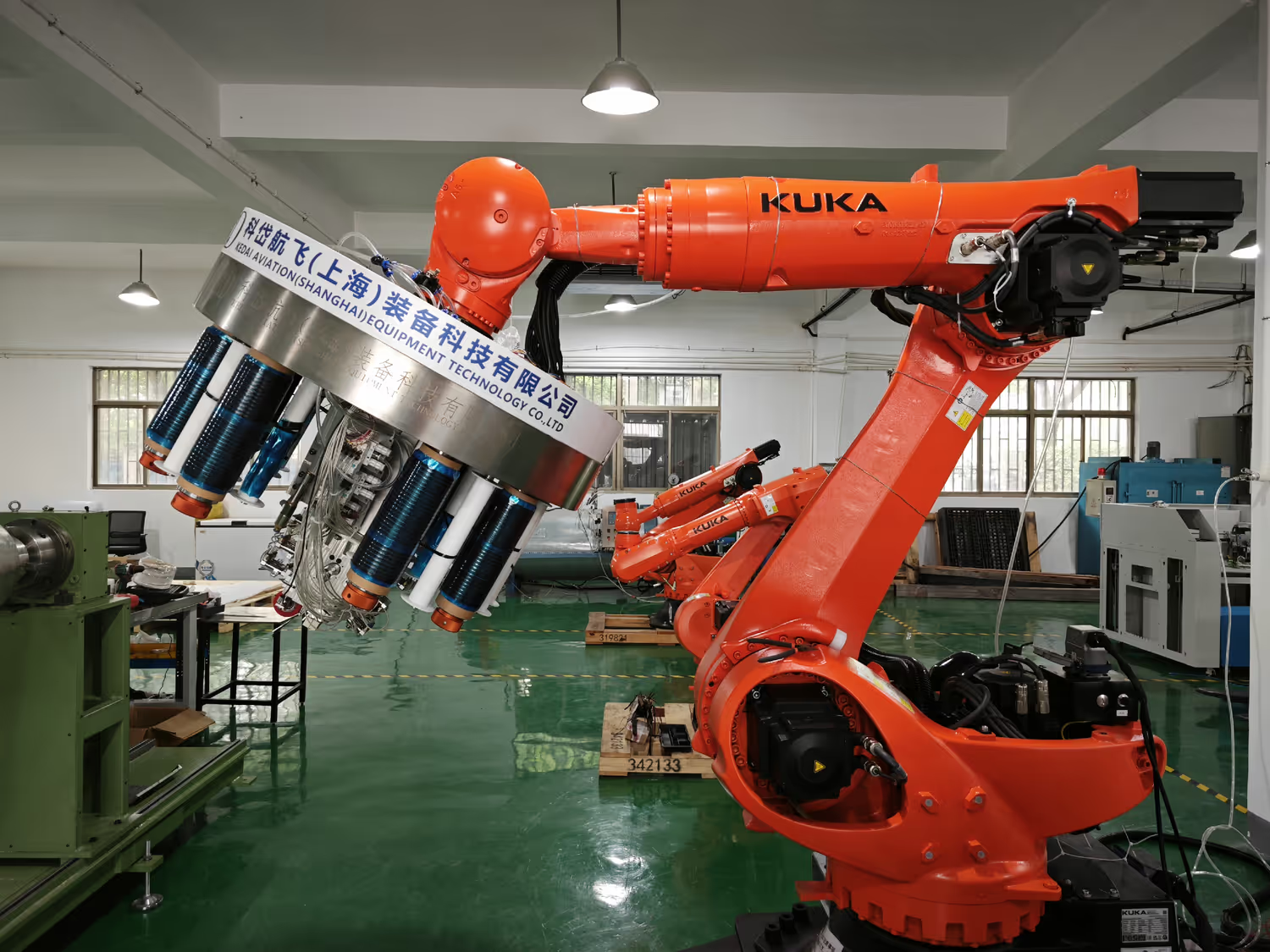
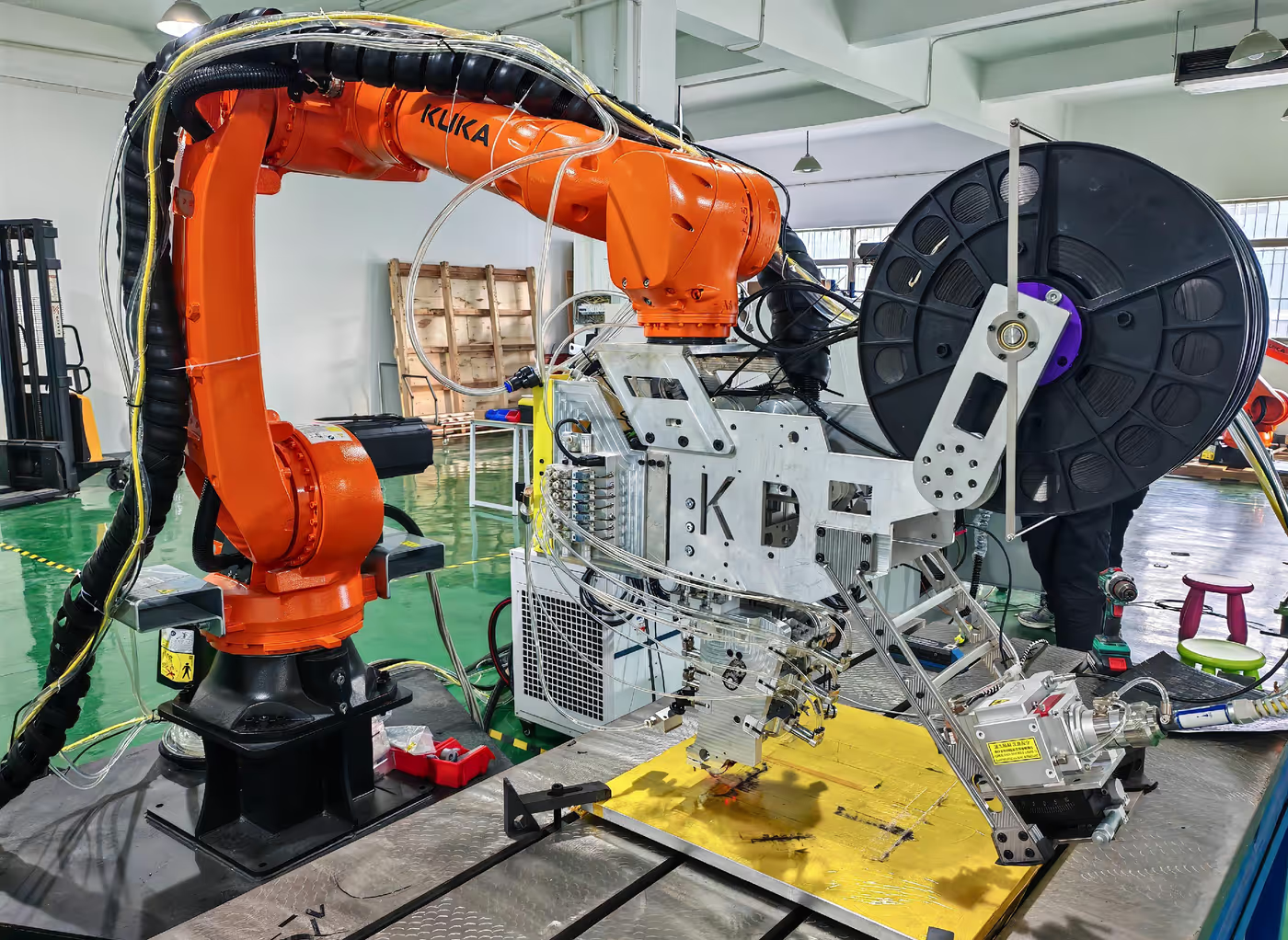
KEDAI Aviation (Shanghai) Equipment Technology Co., Ltd. (科岱航飞) is one of China’s most capable rising AFP manufacturers and a powerful alternative for cost-conscious buyers who refuse to compromise on quality. Based in Shanghai, KEDAI focuses on high-performance composite manufacturing process and equipment technology, offering both thermoset AFP machines and thermoplastic AFP machines in gantry, robotic and horizontal configurations.
KEDAI’s modular placement heads support from 1 to 16 tows, with tow gap accuracy within ±0.5 mm, profile precision within ±2 mm and tow angle error below 1°. Its thermoplastic systems feature laser heating with a 2–12 kW selectable power range and a 100–500 °C controllable temperature window, reaching lay-up speeds of up to 80 m/min on five-axis robotic platforms with 0.05 mm positioning accuracy. All machines are driven by KEDAI’s self-developed KD-AFP V2.0 path planning and post-processing software with independent intellectual property rights.
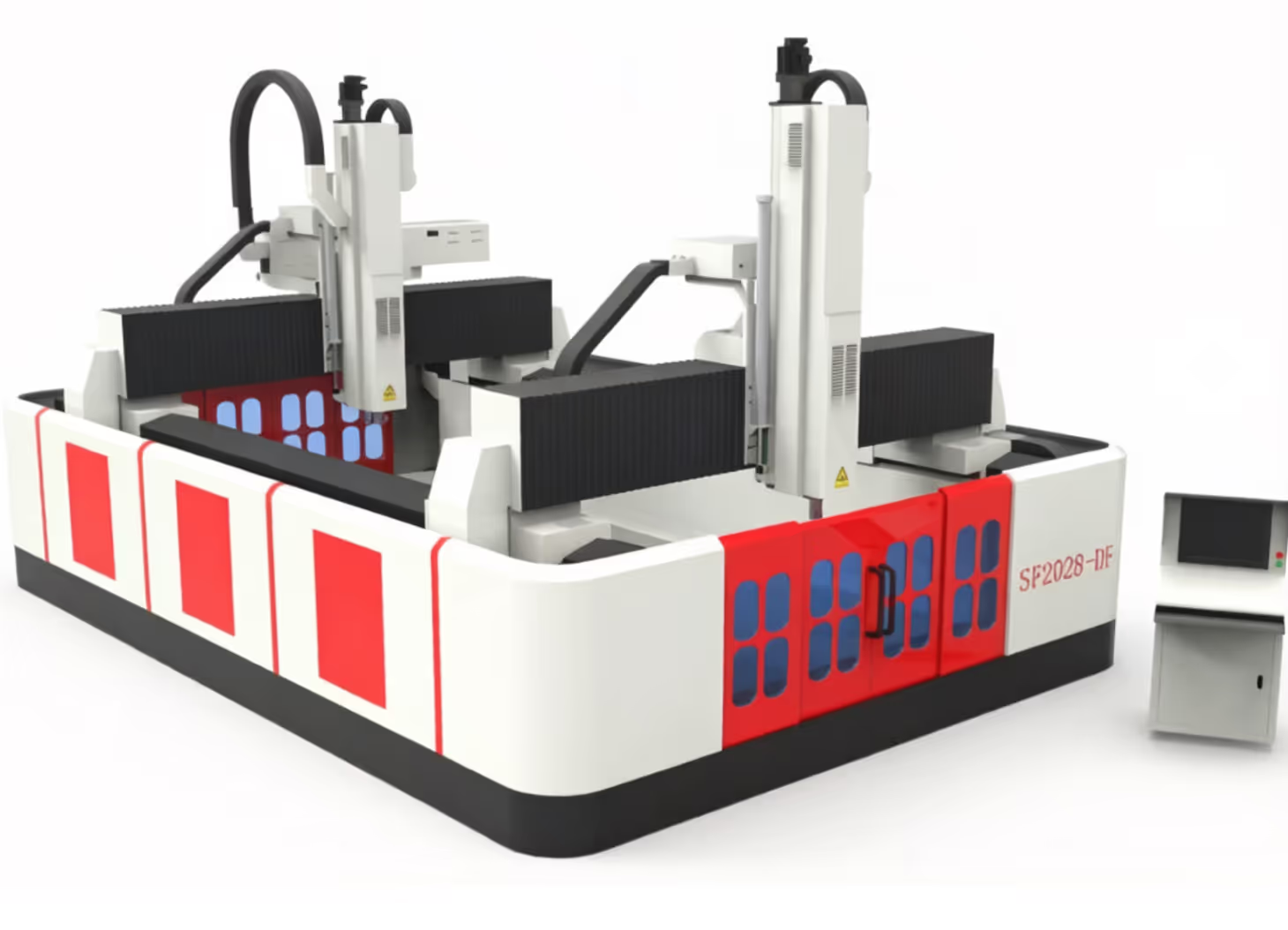
Beyond AFP, KEDAI’s portfolio covers laying-winding integrated machines, high-performance filament winders, continuous fiber 3D printers, thermoplastic ATL equipment and additive-subtractive integrated platforms — supported by more than 10 core invention patents and an aerospace-grade quality assurance system. Its equipment serves airframe sections, fan blades, rocket fuel tanks, radomes, satellite structures and carbon fiber industrial parts. With the positioning of “consumer-grade cost and aerospace-grade quality,” KEDAI Aviation helps customers worldwide upgrade from metal components to carbon fiber, delivering customized, efficient and affordable intelligent composite manufacturing solutions.
Thermoset AFP machine
| Item | Specification |
|---|---|
| Head configurations | 1 / 2 / 4 / 8 / 16 tows lay-up |
| Tow gap accuracy | ≤ ±0.5 mm |
| Profile precision | ≤ ±2 mm; tow angle error ≤ 1° |
| Minimum feed length | 40 mm |
| Heat source | Infrared heating, 60–120 °C (±5 °C control) |
| Maximum lay-up speed | 60 m/min; positioning accuracy 0.05 mm; rotary axis accuracy 30″ |
| Platform | Robot + rotary positioner + linear track; 2,100 / 2,900 mm strokes, customizable |
Thermoplastic AFP machine
| Item | Specification |
|---|---|
| Head configurations | 1 / 2 / 4 / 8 tows lay-up |
| Heat source | Laser heating, 2–12 kW selectable, 100–500 °C (±10 °C control) |
| Minimum feed length | 55 mm; tow gap ≤ ±0.5 mm; profile precision ≤ ±2 mm; angle error ≤ 1° |
| Maximum lay-up speed | 80 m/min; five-axis linkage with rotary and horizontal axes |
| Software | KD-AFP V2.0 self-developed path planning and post-processing |
| Typical parts | Panels, beams, low-curvature and complex large-curvature variable-section components |
Conclusion
The AFP market remains tightly concentrated among a few players who can couple complex placement hardware with integrated software and material handling. Electroimpact dominates large aerospace structures, Coriolis leads robotic flexibility, MTorres excels in thermoplastic in-situ consolidation, and Fives offers battle-tested VIPER® production systems. Emerging from China, KEDAI Aviation is rapidly closing the gap by combining full-spectrum AFP technology, proprietary software and significantly lower total investment. For manufacturers planning their next composite automation investment, these five manufacturers represent the strongest starting points in today’s market.